
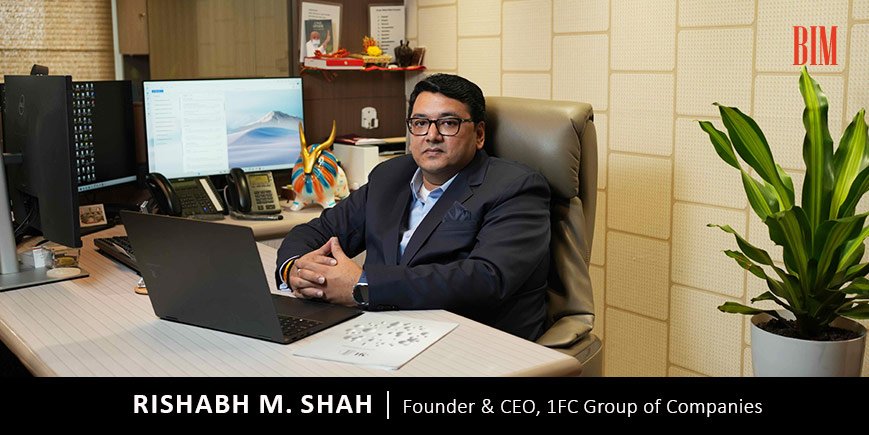
What Will Remain
What Will Remain: Inside 1FC Group’s dual mandate of wealth creation and legacy generation—and why Founder Rishabh M. Shah believes true financial success is measured by what endures beyond you.
“Every big financial decision in the world should answer one crucial question: What will remain after you’re gone?”
Every generation dreams of giving the next one a better start. Parents work tirelessly to provide opportunities they never had; entrepreneurs spend decades building a business; professionals give the prime years of their lives to construct financial security. Yet despite all that effort, most of what they build stays scattered — across investments, insurance policies, bank accounts, loans, and documents known only to one person. A sudden loss, an unforeseen crisis, or the simple absence of a succession plan can undo decades of hard work in a matter of weeks.
The scale of that fragility is not anecdotal. Family-run enterprises generate an estimated 79 percent of India’s GDP, according to HSBC Global Private Banking’s report on Asian family businesses, cited by Angel One, yet succession research consistently shows that only about three in ten of these businesses make it to a second generation, barely one in ten reach a third, and fewer than one in twenty survive beyond that, according to Treelife and the PwC India Family Business Survey. The wealth, in most of these cases, does not vanish because it was poorly invested. It vanishes because nobody built a structure sturdy enough to carry it forward.
The irony is striking. While people devote enormous energy to earning money, very few are taught how to preserve it, grow it, and eventually pass it on with intention. Financial literacy has been reduced to choosing the right product or chasing the highest return, while the larger journey of building something that outlives its creator is left to chance. For Rishabh M. Shah, Founder and CEO of the 1FC Group of Companies, this was more than a gap in financial services. It exposed a deeper weakness in how Indian families relate to money itself — and it became the foundation of a philosophy built on two inseparable ideas: Wealth Creation and Legacy Generation.
SEEING BEYOND THE NUMBERS
“Every entrepreneurial journey begins not with an idea, but with an irritation,” says Rishabh, “something you see repeatedly that the world should have solved by now but hasn’t.” His irritation crystallized over sixteen years in banking and investment advisory, sitting across professionals, entrepreneurs, business owners, and families from every financial background. These were intelligent, financially active people — and yet almost none of them had a coherent view of their own financial lives. A mutual fund here, an insurance policy there, a home loan somewhere else, a forgotten fixed deposit. Different portfolios, different professions, the same fragmentation.
That fragmentation, Rishabh realized, was the real problem. Finances existed in silos, disconnected from one another and from the larger purpose they were meant to serve. Decisions ended up driven by market noise, sales pitches, or immediate need rather than a coherent plan. What people needed, he concluded, was a structured framework — one that shows where they stand today, where they need to go, and how every decision along the way serves that destination.
That realization laid the foundation of 1FC Group and its flagship platform, 1FCode. More importantly, it shaped the philosophy that still guides the organization: financial planning does not end at wealth accumulation. It must also preserve what has been built, prepare the next generation to inherit it responsibly, and ensure that a lifetime of financial decisions keeps creating value long after the person who made them is gone. In 1FC’s own language, this is where Wealth Creation hands off to Legacy Generation.
GUIDED BY TIMELESS WISDOM
The insight behind 1FCode did not come from a market study or a competitor’s pitch deck — it came from the Bhagavad Gita. “Finance and the Bhagavad Gita have more in common than people think,” Rishabh says. “Both provide a structured framework for navigating life’s most consequential decisions.” What struck him was that the text speaks to every level of literacy because it teaches through real situations rather than abstract theory. That led to a simple question: what if financial planning offered the same thing — structured guidance built on real stories, accessible to a 22-year-old first-time earner and a 58-year-old approaching retirement alike?
The scripture’s influence was matched by something far more personal. Growing up in a Gujarati business family, Rishabh absorbed the discipline of money before he could articulate it — tracking every rupee, separating income from expenditure, understanding that financial security is designed, not stumbled upon. That inheritance shaped how he would later read the financial lives of the clients he sat across for more than sixteen years, from first-generation earners to seasoned high-net-worth families.
CHALLENGING THE STATUS QUO
Rishabh carried that inherited discipline into the industry, and he noticed something most people in the room chose to ignore: a widening neglect of financial literacy across the country. “An uninformed investor is easier to sell to,” he says plainly, “and much of the industry behaves as if that were the whole business model.” Compounding this is a structural conflict in the advisory model itself — most advisors earn commissions tied to the products they sell, which tilts advice toward what pays best rather than what actually serves the client, or their children.
That gap between deepening participation and shallow understanding shows up in the numbers. The Reserve Bank of India’s Financial Inclusion Index climbed to 70.0 for the year ending March 2026, up from 67.0 a year earlier, reflecting real progress in access to formal finance, according to Business Standard. Demat accounts have crossed 23.2 crore, a record. Yet active participation tells a different story — barely one in five of those accounts traded in the quarter ending June 2026, according to a Mint analysis of SEBI data. Access has expanded. Genuine understanding has not kept pace.
Rishabh calls the commission-led model and this literacy gap unacceptable, and built 1FCode as their opposite: transparent about how it earns, education-first in how it engages, and designed around outcomes rather than transactions. That intent shows up in 1FC Group’s structure. 1FC Technology houses the platform, advisory framework, and AI layer, while 1FC Insurance Brokers, 1FC Securities, and 1FC Financial and Investment Advisors hold the specific regulatory licenses required to offer insurance, capital market access, and long-term investment planning. Together, they let an individual or family see their entire financial journey in one place — the operational core of Wealth Creation done right.
CHANGING FINANCIAL BEHAVIOUR
Rishabh has sat with enough Indian families working hard to build financial strength, only to watch it scatter into pieces — a statement here, a policy there, a locker nobody can open. “I think about the family that discovers, after losing a loved one suddenly, that they have no idea where the investments are, how many insurance policies exist, or how to access any of it,” he says, “not because the person didn’t plan, but because everything was siloed and nothing was shared.” This is not a rare misfortune. Government disclosures to Parliament put unclaimed bank deposits in India at roughly ₹78,000 crore, alongside nearly ₹14,000 crore in unclaimed insurance proceeds and close to ₹3,000 crore sitting unclaimed in mutual funds — money that legally belongs to someone, inaccessible simply because no one told the family it existed, according to the Press Information Bureau. It is the clearest illustration of what happens when wealth is created without a structure for Legacy Generation to follow.
It is also why Rishabh insists on changing behaviour, not just knowledge. “Personal finance is 20 percent knowledge and 80 percent behaviour,” he says. “Our job at 1FC is to change both.” 1FCode’s successor-access feature and consolidated dashboard exist precisely for this reason. They are not conveniences; they are the practical mechanics of legacy — the plumbing that keeps a family’s financial well-being visible to the people who are meant to inherit it.
“Someone’s sitting in the shade today because someone planted a tree a long time ago.”
— Warren Buffett
It is a line Rishabh could easily have written himself. Wealth Creation plants the tree. Legacy Generation is the discipline of making sure someone else can actually sit in its shade.
TRUST, BUILT INTO THE ARCHITECTURE
1FCode is Rishabh’s most personal project, and it was never treated as a pure technology exercise. Asking families to entrust a platform with their net worth, insurance, loans, and their children’s future is a different kind of challenge — one that demands trust earned one interaction at a time.
The team learned this early. They built the platform’s features around sound financial logic, only to discover the presentation was too technical, too abstract, too distant from how people actually experience money. “The numbers were right, but the story was wrong,” Rishabh recalls. The platform was rebuilt around client-facing scenarios instead — the car loan that stretches a family too thin, the sudden loss of an earning member that locks a household out of its own savings — and engagement changed. The lesson that stuck: “financial behaviour changes when people see themselves in the story, not in the spreadsheet.”
Empathy alone, however, cannot sustain trust in finance. Every promise made on a unified platform for investments, insurance, loans, and tax must be backed by an equally rigorous compliance system spanning SEBI, IRDAI, and RBI regulations simultaneously. Structuring 1FCode as a group of specialised, individually licensed entities was the solution, and Rishabh credits much of that architecture to his late mentor, Shri Arun Shenoy, former Commissioner of Income Tax, whose command of regulatory functions shaped the company’s compliance foundation.
THE INNOVATION MINDSET
At 1FCode, innovation starts with a disciplined ritual: every conversation with a client begins with the client’s experience, not the product the team would like to build. The team works through real scenarios — a young couple taking on a home loan they cannot really afford, a business owner who has never planned succession, a 35-year-old a decade into investing with no clear idea of their own net worth — and asks what would genuinely change that person’s outcome. The gap between what would help and what the industry currently offers is where 1FCode finds its niche.
Rishabh also points to cross-disciplinary expertise as the engine behind that innovation. The company’s Chief Digital Officer brings 17 years of experience building digital platforms and campaigns for global brands including Qualcomm, Reliance Mutual Fund, P&G, and HSBC. That combination of financial depth and technology fluency has produced a platform that financial professionals alone would not have built — one built to question every assumption that disguises a weakness as a strength.
CHANGING THE WAY INDIANS THINK ABOUT MONEY
Asked about his most significant achievement, Rishabh does not reach first for the Startup Special Category award from Finance Outlook India, even though he calls it a milestone he is proud of. He points instead to something quieter: a client telling him that the way they think about money has changed. Clients who once asked “what should I buy?” now ask “does this fit where I want to be in ten years?” That shift, he says, is the hardest thing to produce in financial services — and the most valuable, because it is the difference between wealth that is spent and wealth that is guided.
“An investment in knowledge pays the best interest.”
— Benjamin Franklin
Rishabh also points to a generational shift already underway. Gen Z and millennial investors, he says, are the most digitally fluent cohort India has produced. They have little interest in branch visits or relationship managers, and they are openly skeptical of commission-driven advice. He treats that skepticism as healthy — it favours platforms that are transparent about how they earn, which is exactly the ground 1FC has chosen to build on.
BUILDING A FINANCIALLY AWARE SOCIETY
Rishabh’s ambitions extend well beyond the platform’s current footprint. “In five years, I want every Indian to have one financial address,” he says, “and I want that address to be 1FCode.” Behind that statement sits a concrete plan: presence across 20 cities, localized financial literacy content in regional languages including Gujarati, Marathi, Hindi, and Tamil, and a thriving network of Independent Financial Advisors, Chartered Accountants, and legal professionals using the platform.
The impact he is chasing is not centred on revenue or market share, though both matter. To him, real impact looks like higher financial literacy, fewer preventable family financial crises, more Indians retiring with dignity, and family wealth that survives intact and accessible to the next generation. It is, he adds, the individual-level expression of a larger ambition: to help restore India as “Soney Ki Chidiya” — the golden bird it once was. Wealth Creation builds that bird’s wings. Legacy Generation is what keeps it flying after the builder is gone.
LESSONS FOR ENTREPRENEURS
Find a problem you have lived near, not one you found in a market report. Know your numbers — runway and burn rate only tell you whether the business is alive, not whether it matters. “Build the team before you need it,” Rishabh adds. “Hire for values first; skills can be developed, values cannot be installed.” And be patient. Behavioural change, in a person or in a country, can take years to show — but it is the only kind of change that actually lasts.
“Wealth that is created but never structured to be inherited isn’t legacy — it’s an accident waiting to happen. Our job is to make sure it’s never one.”
— Rishabh M. Shah, Founder & CEO, 1FC Group
